Archive · Site notes
Goodenough Spring
Amistad National Recreation Area · Val Verde County, Texas · 29°32′ N, 101°15′ W
The author's own warning, and it is the point of the page
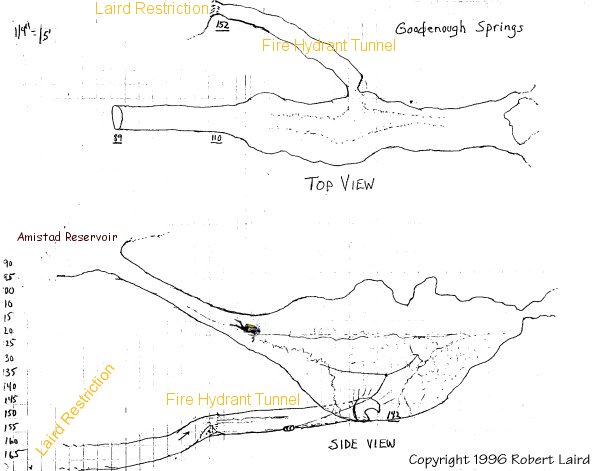
"This is a deep and very dangerous dive, and should be attempted only by experienced cave divers with trimix certification… I've had people misconstrue my intentions on publishing this sketch: it's not an invitation, nor a guidebook. Its purpose is to provide a general concept for planning purposes to experienced trimix cave divers. If you're not one of those guys or gals, then don't even think about it."
The cave
Goodenough is either a fault cave or a joint-plane cave, having a significant vertical profile, with smooth walls of hard chert and large gravel throughout — marble to lemon sized — primarily concentrated at the end of the Fire Hydrant tunnel, with extremely strong outflow.
The end of the Fire Hydrant tunnel represents an extreme restriction, possibly passable only by sidemount or no-mount, but may present digging opportunities; some divers have seen this restriction more open at times. Tunnels towards the rear of the main room in the cave may also be passable by sidemount or no-mount.
Conditions
Visibility in the lake is near zero, and decompression has to be done in lake water — cold in winter, 55–65 °F. Water temperature inside the cave is about 85 °F year-round, one of the most surprising features of Goodenough. More often than not, water clarity inside the cave is poor, under 25 feet, but it has been known to be crystal.
Depths vary with the lake, and vary a great deal
This is the detail most often misread. All quoted depths are relative to the reservoir surface, and Amistad's level moves:
"All the depths are based on the lake level at that time. For example, in my original narrative, I mention the restriction is at 152 ffw… right now it's at a depth greater than 200 ffw. The point is, it varies. Do not think 'oh, it's only 30 feet beyond the recreational limit and that will be okay' because there's a good chance it's way beyond that. Trying to dive this cave on air will very likely get you narc'd, tox'd, bent or worse."
At the lake levels of the period described here the cave opening sat at roughly 100–110 feet. Later published accounts place the mouth around 165 feet below normal pool level. Both figures can be correct — the spring has not moved, the lake has.
Getting there
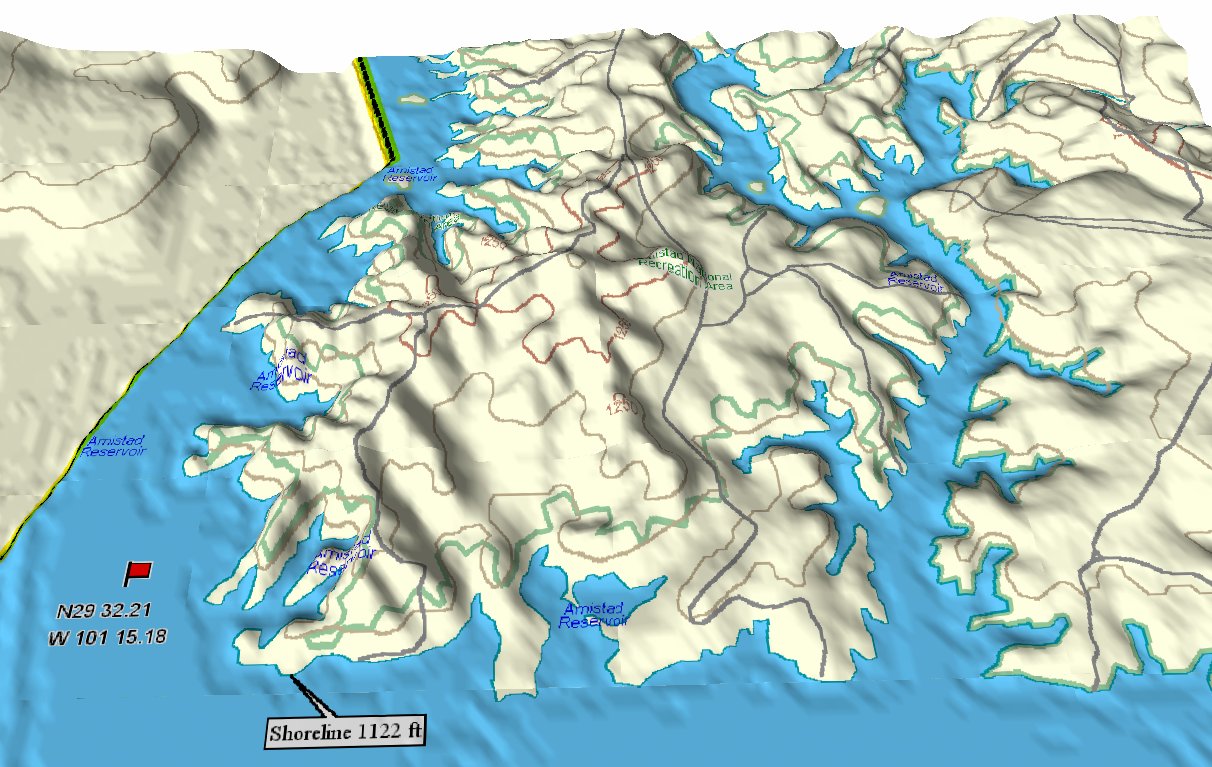
Check in with the National Park Service rangers. The spring is located near Buoy 18; you will not find it unless you or your buddy have been there before. From Diablo East Marina it is a ninety-minute boat ride, so take two sets of doubles and stages, food and water for the whole day, and warm and waterproof clothing if it is below 70 °F outside. From Box Canyon it is thirty to forty minutes, but the drive for air fills from Box Canyon is at least twenty-five minutes each way. If using a boat, get a boat permit.
The original page also carried Del Rio lodging, air fill, boat rental and gas supplier listings with phone numbers, plus the nearest recompression chamber in San Antonio. Those have been removed rather than reproduced — every one of them dates from 2005 or earlier and several were already marked "not any more!" by the author. Confirm current services locally, and confirm the nearest operating chamber before you dive.